
TMJ Disorder Treatment: Understanding and Relieving Jaw Joint Pain
The temporomandibular joints connect your lower jaw to your skull, one on each side just in front of the ears. They work every time you speak, chew, yawn or swallow. When the joints or the muscles around them become strained or damaged, the result is a temporomandibular disorder, commonly called TMJ disorder or TMD.
Symptoms are easy to mistake for ear problems, sinus trouble or migraines, so many people spend months looking for the cause.
Common symptoms
- Pain or tenderness in the jaw, face, neck or in front of the ear
- Clicking, popping or grating sounds when opening or closing
- Limited mouth opening or the jaw feeling stuck or locked
- Headaches, especially in the temples or on waking
- Ear fullness or ringing without an ear infection
- Worn, chipped or sensitive teeth
- Difficulty biting evenly or a bite that feels different
Not every click means a disorder. Painless joint noise with normal movement often needs no treatment, but pain, locking or restricted movement should be examined.
What causes TMJ problems?
TMD usually has more than one contributing factor:
- Clenching or grinding the teeth, often during sleep (bruxism)
- Stress and muscle tension
- Injury or trauma to the jaw
- Displacement of the cartilage disc inside the joint
- Arthritis affecting the joint
- Missing teeth or an uneven bite, which may overload one side
- Habits such as nail biting, chewing gum for long hours or resting the chin on the hand
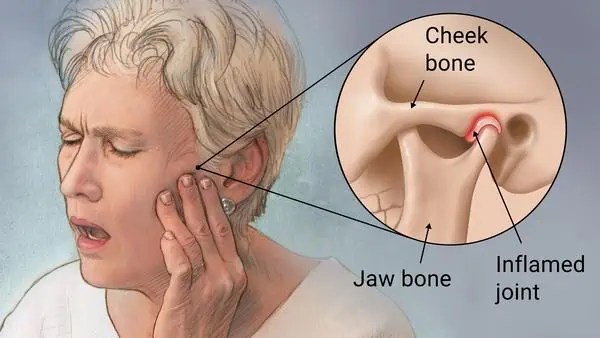
How TMJ disorders are diagnosed
Diagnosis begins with a detailed history and a physical examination of the jaw muscles, joint movement and bite. Your dentist will check how far you can open, whether the jaw deviates and where it hurts. Imaging, such as a panoramic X-ray or a cone beam CT, may be used to look at the bone of the joint, and in some cases an MRI shows the disc. See our guide to 3D imaging in dentistry for how scans help.
Role of restorative and bite care
In patients with extensive tooth wear or an unstable bite, TMJ care may be followed by rebuilding the bite in a planned way, as described in our article on full mouth rehabilitation. This is done only after the muscles and joints are comfortable, so the new bite is stable.