
Dental Bridges for Missing Teeth in Trivandrum
A missing tooth doesn't just leave a gap — it can affect how neighboring teeth shift, how you chew, and how confident you feel smiling. Dental bridges are one of the long-standing solutions for replacing one or more missing teeth. Here's what to know.
What Is a Dental Bridge?
A dental bridge is a fixed prosthetic that "bridges" the gap created by one or more missing teeth. It typically consists of one or more artificial teeth (called pontics) held in place by crowns attached to the natural teeth or implants on either side of the gap. Unlike removable dentures, bridges are cemented in place and function much like natural teeth.
Why Are Bridges Recommended?
Replacing a missing tooth with a bridge addresses several issues at once:
- Prevents shifting — neighboring teeth can drift into the empty space over time, causing bite problems
- Restores chewing function on the affected side of the mouth
- Maintains facial shape by filling the gap that can otherwise cause a sunken appearance
- Improves speech, since gaps can affect pronunciation of certain sounds
- Restores appearance and confidence, closing a visible gap in your smile
- Distributes bite force evenly, reducing strain on remaining teeth
When Should You Consider a Bridge?
A bridge may be a good option if:
- You have one or a few missing teeth in a row
- The teeth on either side of the gap are healthy enough to support crowns (or you're open to implant-supported bridge options)
- You prefer a fixed, non-removable solution over a removable denture
- You want a quicker, less surgical alternative to individual implants for multiple missing teeth
- Neighboring teeth already need crowns for other reasons, making a bridge an efficient combined solution
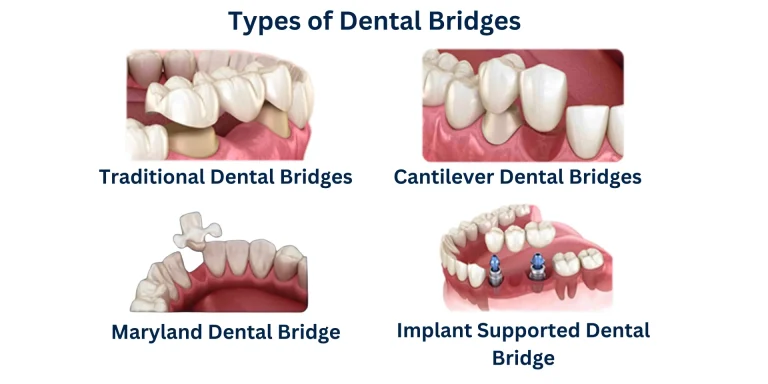
Types of Dental Bridges
- Traditional bridge — uses crowns on both neighboring teeth to support the pontic
- Cantilever bridge — supported by a crown on only one side, used when there's only one adjacent tooth
- Maryland bridge — uses a metal or porcelain framework bonded to the back of neighboring teeth, with less alteration to those teeth
- Implant-supported bridge — anchored by dental implants rather than natural teeth, ideal when several teeth are missing in a row
What Does the Procedure Involve?
- Preparation — the supporting teeth are reshaped to receive crowns (for traditional and cantilever bridges)
- Impression or digital scan — used to custom-fabricate the bridge
- Temporary bridge — worn while the permanent one is made
- Final placement — the bridge is checked for fit and bite, then cemented into place
Visit Dr. Kashi's Ashwathi Dental Clinic
If you're missing one or more teeth and want a fixed, natural-looking solution, our team can help determine whether a bridge is right for you. Book a consultation at Ashwathi Dental Clinic today.